
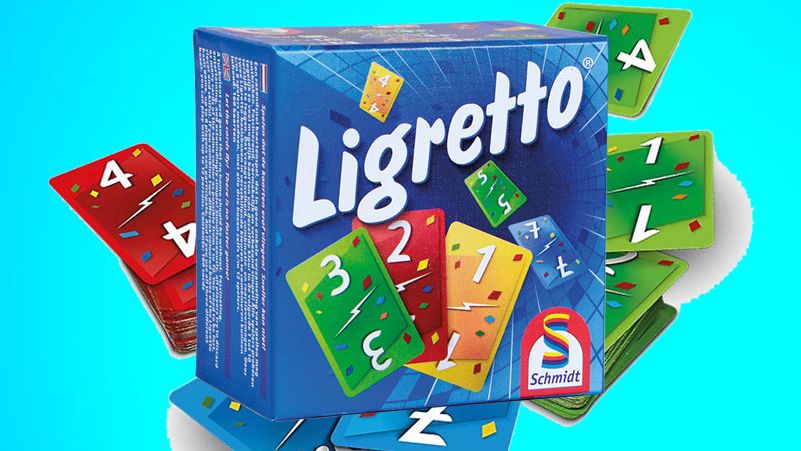
When we create documentation for our clients, we do so based on the principles of Minimalism (see the box below). Within our field, these principles are considered best practice. In this blog, I share four tips for writing minimalist instructions. I'll illustrate them using a practical example: the card game Ligretto.
Minimalism According to Hans van der Meij
Minimalism is a design philosophy. It is a use‑centered approach because its priority lies in supporting the use of an application. It is also a user‑centered approach because it adapts to the audience as much as possible. The principles and heuristics of minimalism are not rules to be followed blindly or rigidly; they simply enable better designs. In addition, they are effective only when combined with a thorough understanding of basic design issues such as context, audience and task analyses.
The four main design principles of minimalism are:
Choose an action‑oriented approach. Users typically want to do things. This principle reflects the use‑centered nature of minimalism.
Anchor the tool in the task domain. A tool is a means to an end. This principle asks designers to select training tasks that are meaningful to the user.
Support error recognition and recovery. To err is human. There are several ways to increase user competence and comfort when dealing with mistakes.
Support reading‑to‑do, study, and locate. Designs should fit, as much as possible, the diverse needs and preferences of the intended audience. This principle reflects the user‑centeredness of minimalism.
Source: Hans van der Meij, 2019
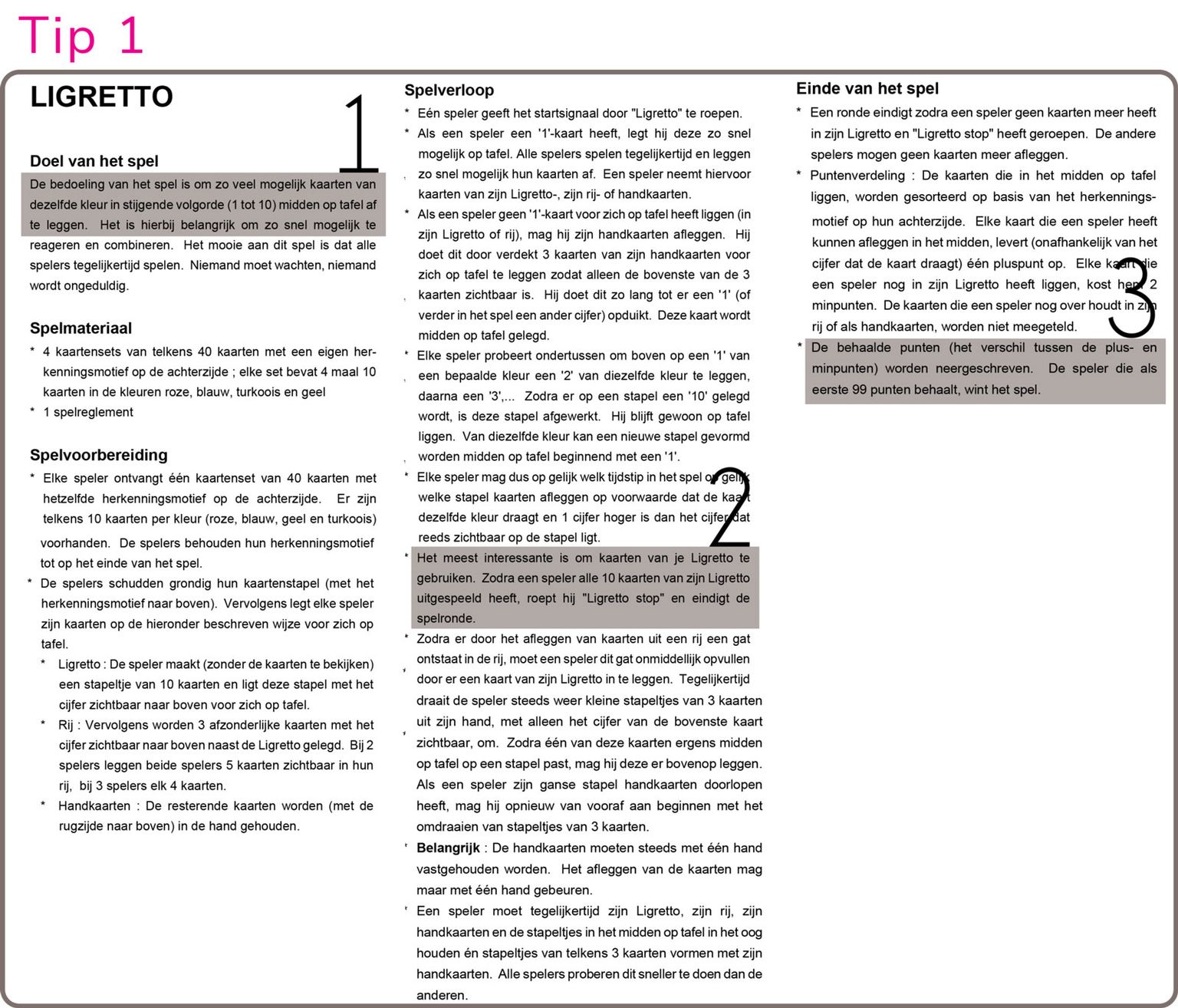
Tip 1: Be clear about the goal
In the instruction, a goal is mentioned in three different places (see image Tip 1). Each goal is on a different level:
How to play cards away
How to win the round
How to win the game
The game has multiple goals; this is common in instructional materials. Give the user clarity right away in the introduction, for example by explicitly stating the different goals.
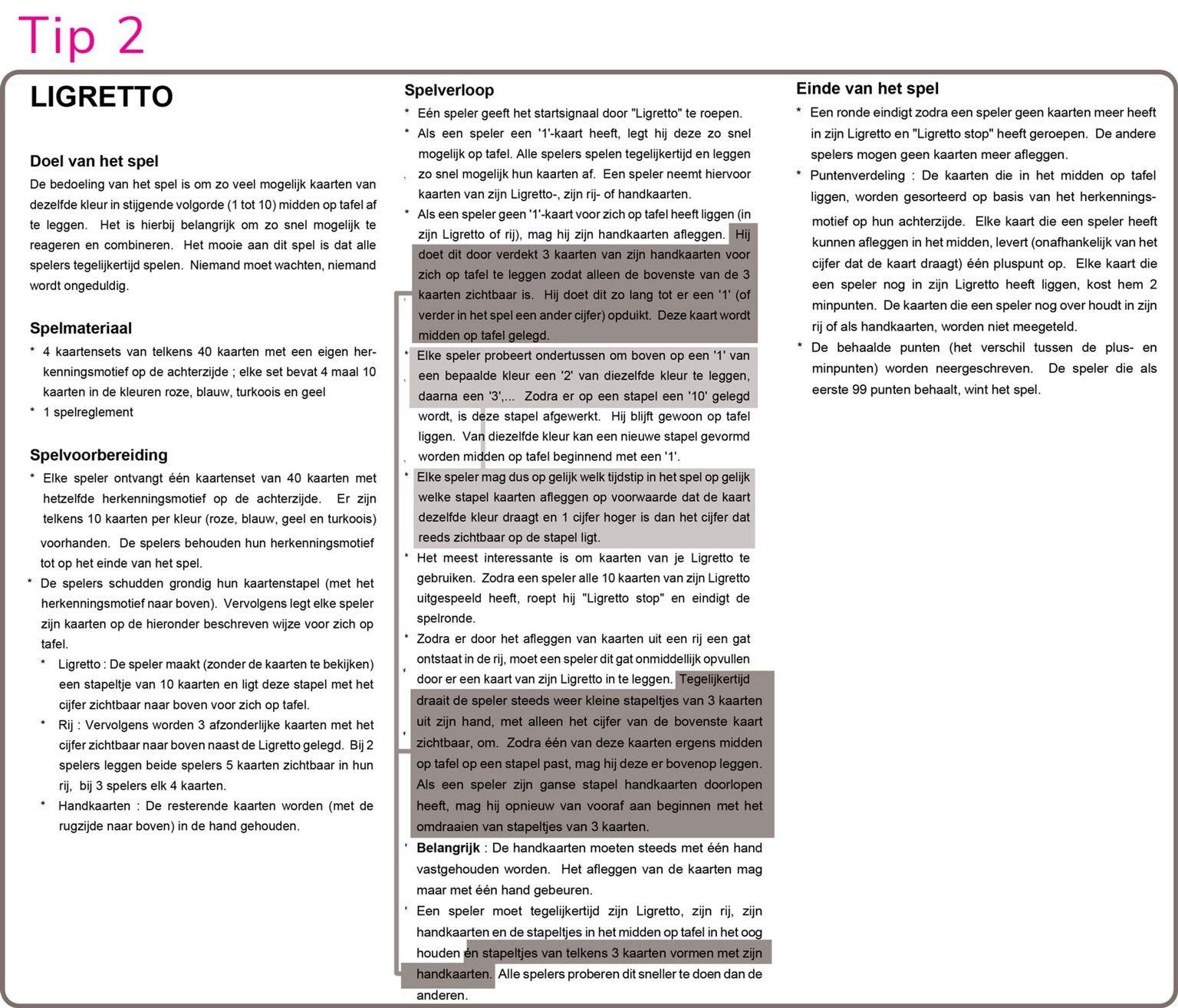
Tip 2: Avoid repetition
People often say: “Repetition is the best teacher.” This does not apply to instructions. Your reader wants to take action and preferably read as little as possible. Definitely not the same information twice. From the user’s perspective: “the best instruction is no instruction.”
This manual contains a lot of duplication. In the image under Tip 2, two examples are shown. The dark‑shaded information even appears three times in the manual! If your information contains duplicates, the structure of your instruction is not optimal. Make sure all actions in your manual are described in chronological order. Remove all repetitions.
Bonus tip: If you use the word “so” in an instruction, you are often describing the same information a second time!
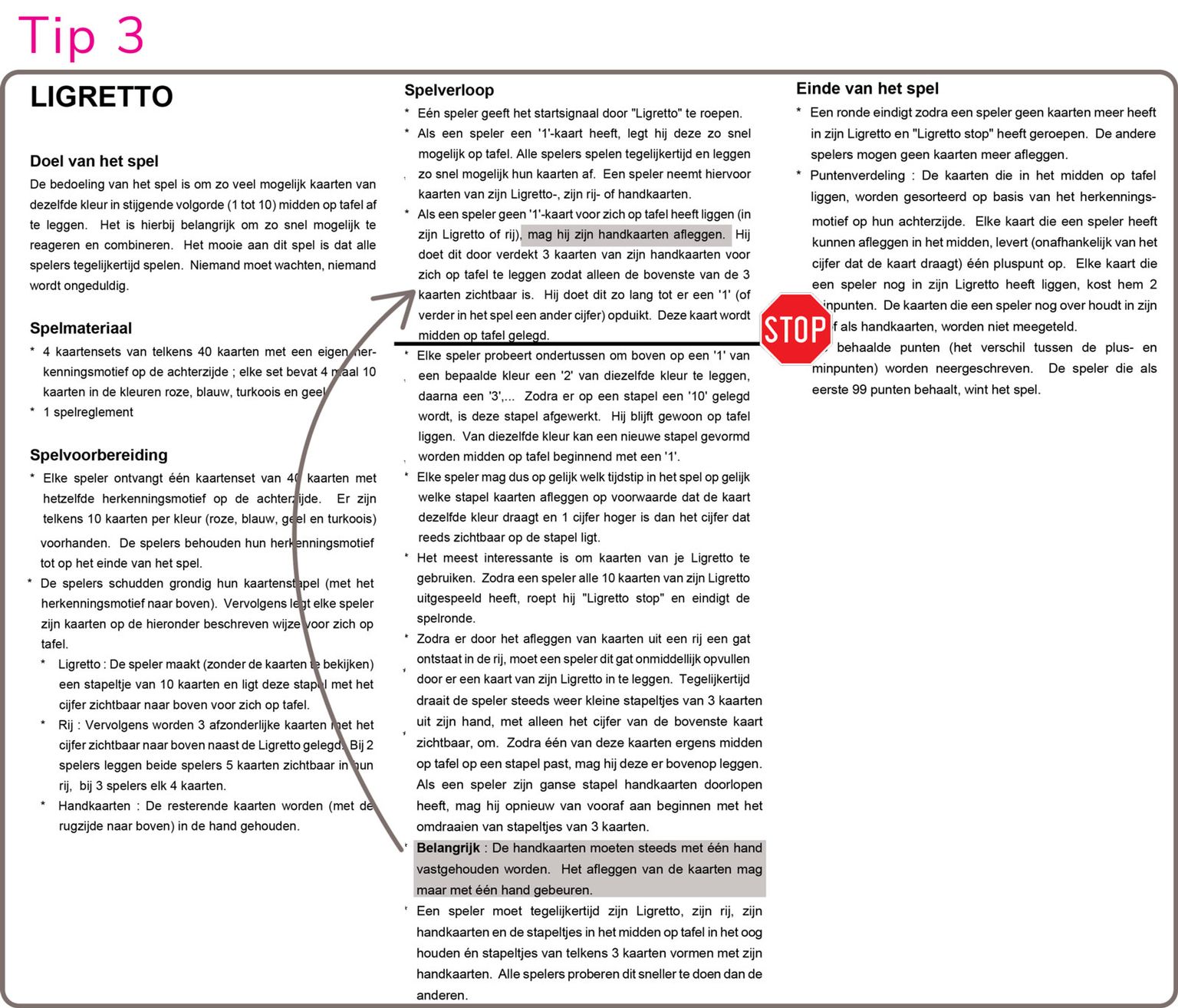
Tip 3: Place warnings where they are needed
Before I started playing Ligretto, I read the instructions up to the stop sign (see image Tip 3). That is quite far, compared to my fellow players. But this is my profession, after all. While writing this blog, I discovered a “Important” notice later in the text referring to something I had already read.
This leads to the next tip: Always place warnings exactly at the action they refer to.
Tip 4: Visualize
Children think in images until about age four. Most people shift to thinking in words after that. But visual thinking remains your primary way of understanding something. Because of this, you understand things more quickly when you see an image. You can use this natural tendency in instructions.
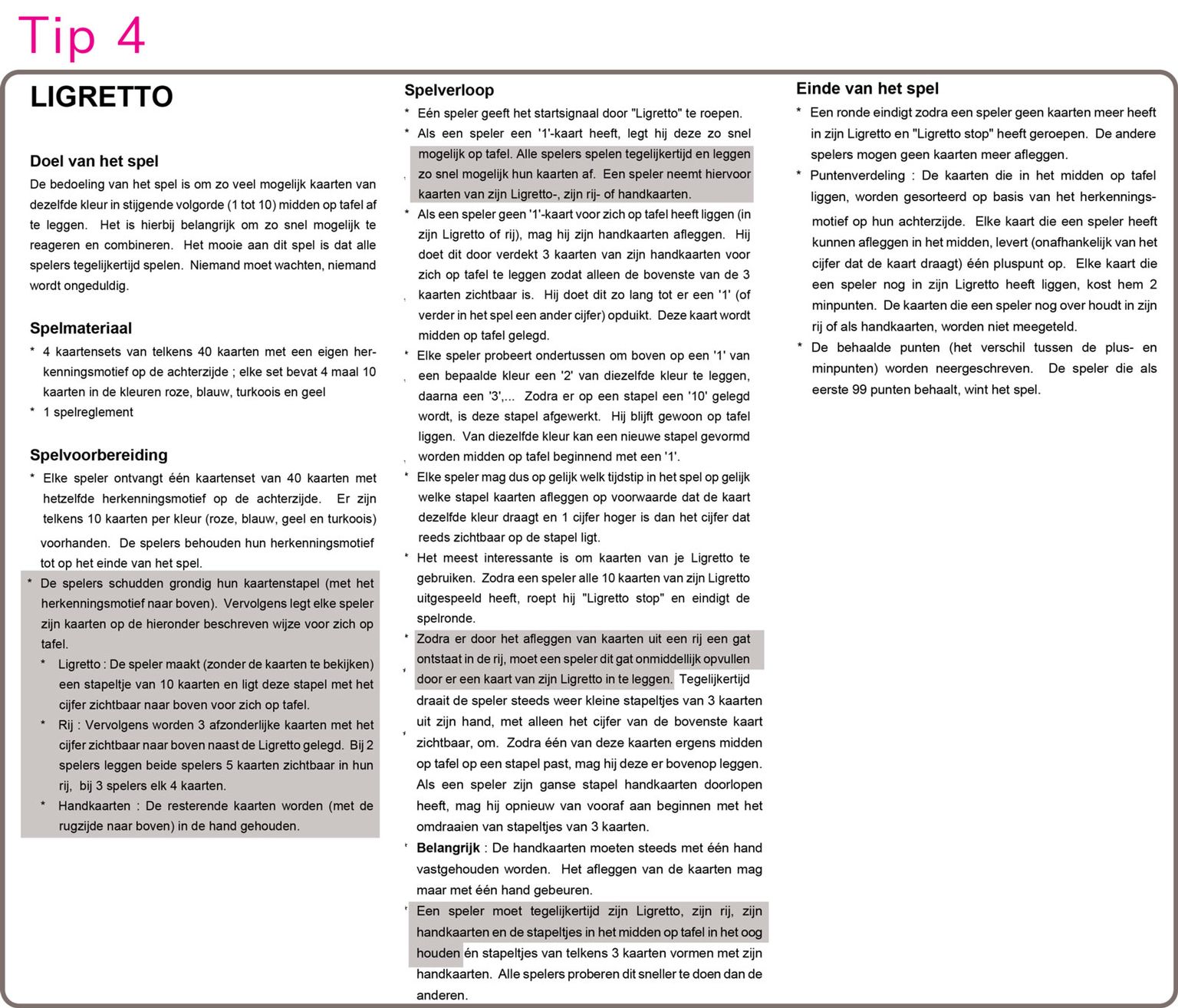
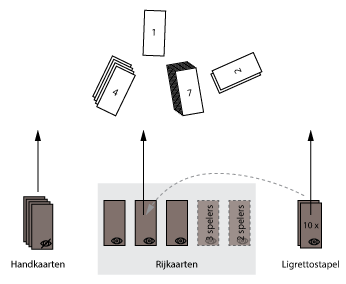
The shaded information in image Tip 4 can be summarized as:
Conclusion
Summarize the goal clearly, remove all duplications from the instruction, place warnings where they are needed and visualize as much as possible. This leaves far less text to read. The likelihood that your user will actually read the instruction increases significantly.
Also nice: Use SwipeGuide software for a digital instruction. A QR code on your product can link to this instruction. This is especially appealing for younger audiences. Example: https://animo.swipeguide.com/guide/optime
Would you also like a minimalist instruction but don’t know where to start? We are happy to help!