Researcher Pedro de Bruyckere caused quite a stir at the Dommelvalley event when he demonstrated that many commonly held beliefs about education and learning are not supported by scientific evidence.
One theory after another: models I had learned during my studies in Educational Sciences and Psychology was debunked. For example, I learned that Maslow’s pyramid does not actually exist in the form we often see (Maslow described a hierarchy, and even added two more categories later), and that it makes no sense to adapt education to students’ learning styles (because there is a difference between how people say they like to learn and what actually helps them learn).
Did you believe in any of these theories? That’s not unusual. We often receive confirmation of these “theories” through practical experiences (Mildenhall & Williams, 2001). We fall victim to false and selective memories (De Bruyckere, Kirschner & Hulshof, 2015). In other words, we suffer from confirmation bias.
Learning Something New or…?
Misconceptions that contradict scientific findings exist among both children and adults (Bursal, 2012; Bulunuz & Jarrett, 2010). Pedro de Bruyckere calls them “urban myths,” but they remind me of the term “misconceptions.”
My thesis research focused on misconceptions. Misconceptions are persistent and therefore difficult to address. Teaching should not merely aim to explain new content, but to change or confirm existing intuitive ideas (Levitt, 2001; Mayer, 2008).
"Misconceptions are intuitive conceptions incompatible with scientific knowledge and are particularly resistant to change through schooling and other daily experiences."
Levin & Druyan ,1993, p. 1572
A Persistent Misconception Investigated
Students hold misconceptions about many topics, especially in the domain of physical motion (Digisi & Yore, 1992; Kozhevnikov, Gurlitt & Kozhevnikov, 2013; Vosniadou, Ioannides, Dimitrakopoulou & Papademetriou, 2001).
Examples include the belief that an object needs a continuous force to stay in motion, or that an object shot through a curved tube will continue moving in a circular path instead of a straight line. Newton’s first law provides the scientific explanation for these phenomena, but students hold intuitive ideas that contradict it.
In my research, I compared two types of media: hands‑on lessons and online lessons, as well as combinations of both. In hands‑on lessons, students experiment with physical materials. In online lessons, they experiment through computer simulations.
(Which) Medium Is the Solution?
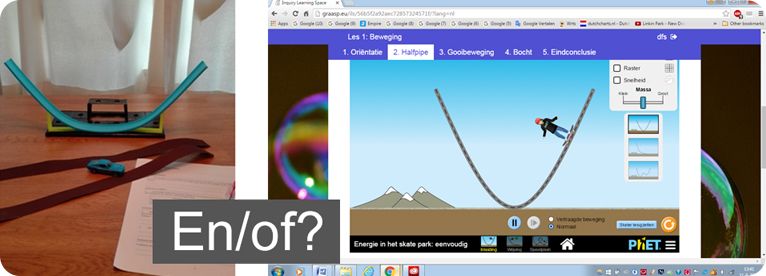
My research showed that the medium, physical materials or computer simulations, does not make a difference. Had I read De Bruyckere, Kirschner and Hulshof (2015) earlier, I might have expected this outcome. Clark (1983) argues that it is not the technology or medium that makes the difference, but the teaching method. In all lessons, the same method was used (inquiry‑based learning), so it is not surprising that no differences were found.
According to De Bruyckere, there is no single medium or method that is universally effective. It is more interesting to investigate why a certain medium or method works in one situation and not in another. A valuable addition to my research, for example, could have been to conduct interviews to see what students did or did not appreciate about the lessons.
How Do You Counter Misconceptions in Education?
The first step toward genuine understanding is to question your own assumptions (Posner, Strike, Hewson & Gertzog, 1982). Identify misconceptions in yourself and your students (Mildenhall & Williams, 2001).
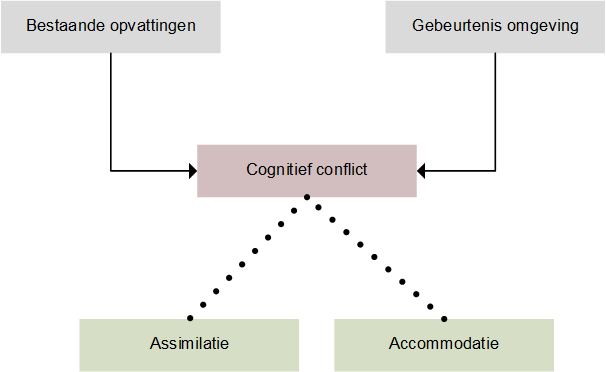
In conceptual change theories, Piaget’s theory of equilibration is often used as a foundation, or its strategies can be recognized within these theories (Bulunuz, Jarret & Bulunuz, 2009; Mildenhall & Williams, 2001). Individuals already have existing mental models and intuitions about the world. When an event occurs that conflicts with these existing beliefs, a cognitive conflict arises. To resolve this conflict, either assimilation or accommodation may take place.
The emphasis should be placed on the core facts rather than making the incorrect information more familiar (Cook & Lewandowsky, 2011). It may help to focus attention on the key facts by presenting the correct information in graphs, as well as through titles and headings (Cook & Lewandowsky, 2011).
Conclusion
Pedro De Bruyckere helped me realize that educational professionals, including myself, are also susceptible to educational myths and misconceptions. Unfortunately, misconceptions tend to be persistent and difficult to change. The answer to the question of how best to address them appears, much like the myths themselves, to be nuanced.
Perhaps the most important lesson, however, is to remain critical of your own beliefs and assumptions. The theories described here are not necessarily the definitive answer either. Instead, educators should continuously reflect on which teaching approach is most effective in their specific context when addressing misconceptions.
"The important thing is not to stop questioning. Curiosity has its own reason for existing." — Albert Einstein
Sources
Bulunuz, N., & Jarrett, O. S. (2010). The effects of hands-on learning stations on building American elementary teachers’ understanding about earth and space science concepts. Eurasia Journal of Mathematics, Science & Technology Education, 6(2), 85-99.
Bulunuz, M., Jarrett, O. S., & Bulunuz, N. (2009). Middle school students’ conceptions on physical properties of air. Journal of Turkish Science Education, 6(1), 37-49.
Bursal, M. (2012). Changes in American preservice elementary teachers’ efficacy beliefs and anxieties during a science methods course. Science Education International, 23(1), 40-55.
Chinn, C. A., & Brewer, W. F. (1993). The role of anomalous data in knowledge acquisition: A theoretical framework and implications for science instruction. Review of educational research, 63(1), 1-49.
Clark, R. E. (1983). Reconsidering research on learning from media. Review of Educational Research, 53(4), p. 445-459.
Cook, J. & Lewandowksy, S. (2011). The debunking handbook. St. Lucia, Australia: University of Queensland. Geraadpleegt van http://www.skepticalscience.com/docs/Debunking_Handbook.pdf
De Bruyckere, P., Kirschner, P. A. & Hulshof, C. D. (2015). Urban myths about learning and education (1). London, UK: Elsevier.
DiGisi, L. L., & Yore, L. D. (1992, March). Reading comprehension and metacognition in science: status, potential and future direction. Paper presented at the Annual Meeting of the National Association for Research in Science Teaching, Boston.
Kozhevnikov, M., Gurlitt, J., & Kozhevnikov, M. (2013). Learning relative motion concepts in immersive and non-immersive virtual environments. Journal of Science Education and Technology, 22(6), 952-962. doi: 10.1007/s10956-013-9441-0
Levin, I., & Druyan, S. (1993). When sociocognitive transaction among peers fails: The case of misconceptions in science. Child Development, 64(5), 1571-1591.
Levitt, K. E. (2001). An analysis of elementary teachers’ beliefs regarding the teaching and learning of science. Science education, 86(1), 1-22. doi: 10.1002/sce.1042
Mayer, R.E. (2008). Learning and Instruction (2nd ed). Upper Saddle River, New Jersey: Pearson Merril Prentice Hall.
Mildenhall, P. T., & Williams, J. S. (2001). Instability in students’ use of intuitive and Newtonian models to predict motion: the critical effect of the parameters involved. International Journal of Science Education, 23(6), 643-660. doi: 10.1080/09500690117839
Otten, M.D. (2016). Assessing the effectiveness of hands-on lesson, online lessons or combinations of both for tackling students’ misconceptions. (master thesis). Geraadpleegt van http://essay.utwente.nl/70913/1/Otten_MA_BMS.pdf
Posner, G. J., Strike, K. A., Hewson, P. W. & Gertzog, W. A. (1982). Accomodation of a scientific conception: Toward a theory of conceptual change. Science education, 66(2), 211-227.
Vosniadou, S., Ioannides, C., Dimitrakopoulou, A., & Papademetriou, E. (2001). Designing learning environments to promote conceptual change in science. Learning and Instruction, 11, 381-419.
Warm regards, Maaike Otten
m.otten@eluxis.com
Linkedin: Maaike Otten