
Today, I would like to introduce you to an old passion of mine. It goes by the somewhat unusual name S → NP VP. If you have not studied linguistics, as I did, you might think: what does that mean? Yet in the 1960s and 1970s, this formula represented one of the most important insights in linguistics. It can be compared, in a way, to Einstein’s famous formula E = mc².
What was one of the main insights in linguistics in the 1960s and 1970s?
S → NP VP
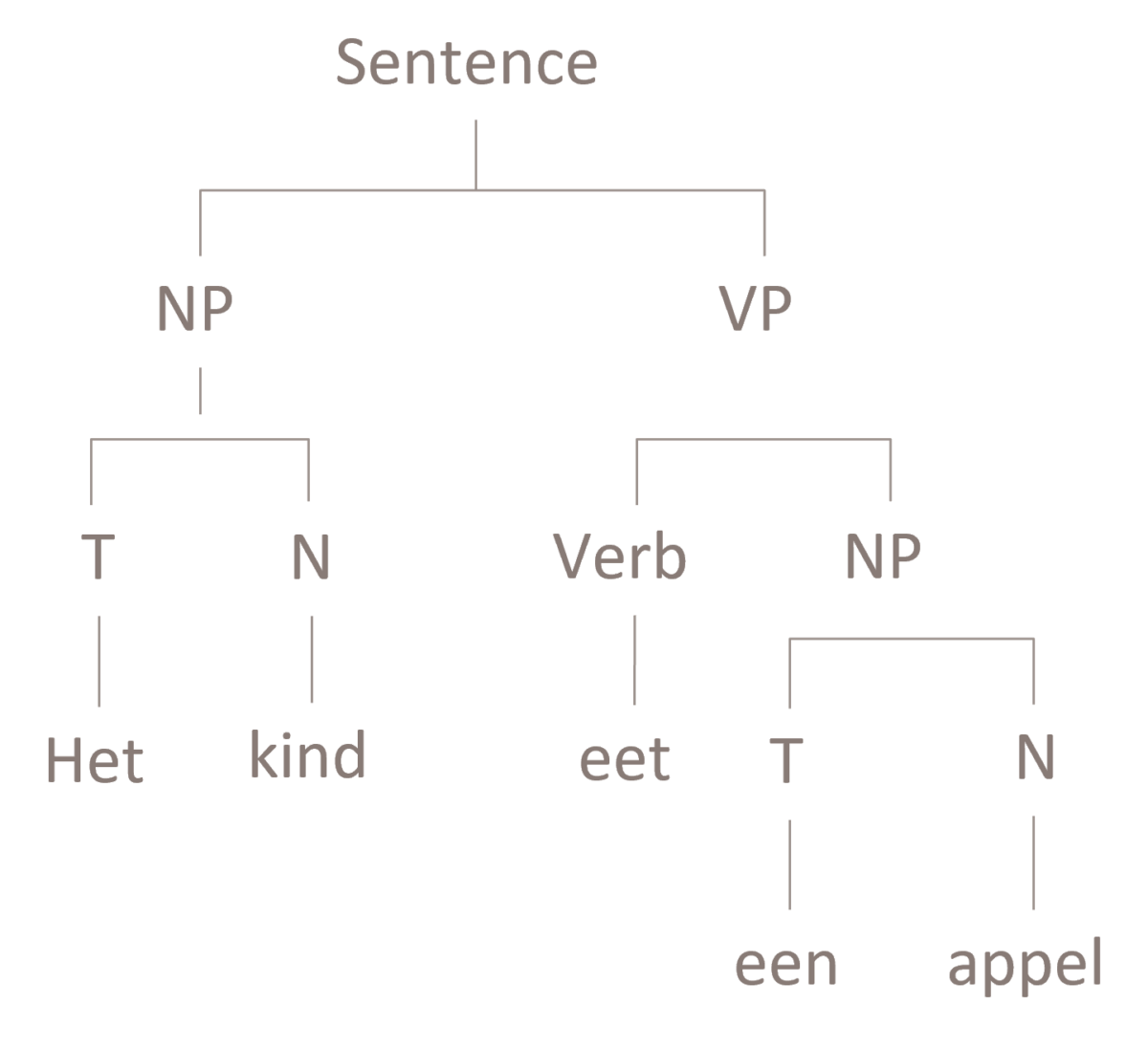
What does this represent? A sentence (S) consists of a noun phrase (NP, Noun Phrase) and a phrase with a verb as its core, a verb phrase (VP). An example. The sentence The child eats an apple consists of the noun phrase the child and the verb phrase eats an apple. The verb phrase itself consists of a verb (eats) and a noun phrase (an apple). From this, you can formulate the rule: VP-> V NP. This states that a verb phrase consists of a verb and a noun phrase. This is where it becomes interesting. With simple rules like these, it is possible to construct complex structures.
Turning language into a tree structure
The language structures described in this way can be represented as a tree. Try drawing one yourself. A sentence (S) is composed of an NP and a VP underneath it. The VP then branches into a V and an NP. From the 1960s onward, linguistics has been full of these kinds of tree structures.
What is generative linguistics?
The founder of this approach is Noam Chomsky, one of the most influential linguists of all time. This linguistic framework is known as generative linguistics. The rules that are formulated generate language. By defining these explicit rules, it becomes possible to describe and explain how language is structured. In this way, we gain a better understanding of language. According to Chomsky, it also helps us better understand what happens in our minds when we learn and use language.
Is generative AI comparable to generative linguistics?
Today, we have generative AI, which can generate language, software code, images, and more. Is this comparable to generative linguistics? According to Chomsky, who is now 96 years old, it is not.
Generative AI works with probabilities. It gathers information and combines it into something new. In that sense, it generates new output. However, it does not provide rules. Everything is based on probability and statistics, which determine the most likely combinations of letters and words, and those combinations are then generated.
According to Chomsky, this means generative AI does not make us wiser. It does not help us understand why things are the way they are and why they could not be otherwise. These are precisely the kinds of insights science is seeking, and this, in his view, is what constitutes real intelligence.
This is a valid observation by Chomsky. However, an interesting development is that Gasper Begus from the University of California, Berkeley uses generative AI to create tree structures for sentences. This works surprisingly well. Generative AI then produces the tree structures for sentences that linguists know so well. Does this mean AI actually understands more about language than we might expect?
That same Gasper Begus also notes that generative AI has brought renewed attention to language and linguistics. That is, of course, something that pleases me greatly, because an old passion never truly fades.
How can AI be applied?
At Eluxis and Demcon, we are actively exploring the application possibilities of AI. One interesting use case is employing AI to make information easier to find and search. Traditionally, this is done by structuring information in document management systems and assigning characteristics or metadata on which searches can be performed. This is a labor‑intensive process.
AI can help by making information discoverable in different ways, requiring less effort and offering greater flexibility. Would you like to explore this together? Feel free to contact us to schedule an appointment. We will make sure you gain truly new insights that you can build on.
P.S. An interesting fact is that Chomsky worked throughout his career at the prestigious MIT, the Massachusetts Institute of Technology. As a linguist, he has always carried out his work in a highly technological environment. The article in which Chomsky presents his view on AI was published in The New York Times under the title The False Promise of ChatGPT.
Warm regards, Peter van Bart
info@eluxis.com
Linkedin: Peter van Bart